
The best apps for Shanghai cover everything you need before and after you land — getting around, payments, messaging, food delivery, and translation. Whether you’re visiting for a week or moving here for work or study, having the right apps installed before you arrive will make your life significantly easier.
Many everyday services that back home you’d handle with cash, a website, or a phone call are done exclusively through mobile apps in Shanghai.
Need mobile data and access to Google, WhatsApp and Instagram in China?
See my guide to eSIMs for China.
Best Apps for Shanghai: Quick List
- DiDi — ride-hailing and taxis
- Amap — navigation and public transport
- WeChat — messaging, payments and daily services
- Alipay — mobile payments
- Pleco — Chinese dictionary and translation
- Ele.me or Meituan — food delivery
- Dianping — restaurant reviews and deals
- Taobao — online shopping
Getting Around Shanghai
These are the two apps you’ll use most from the moment you land.
DiDi
DiDi is China’s equivalent of Uber and the most practical way to get around Shanghai, particularly if you don’t speak Mandarin. It works better than trying to hail a taxi on the street — drivers are easier to locate, fares are shown upfront, and payment is handled in-app.
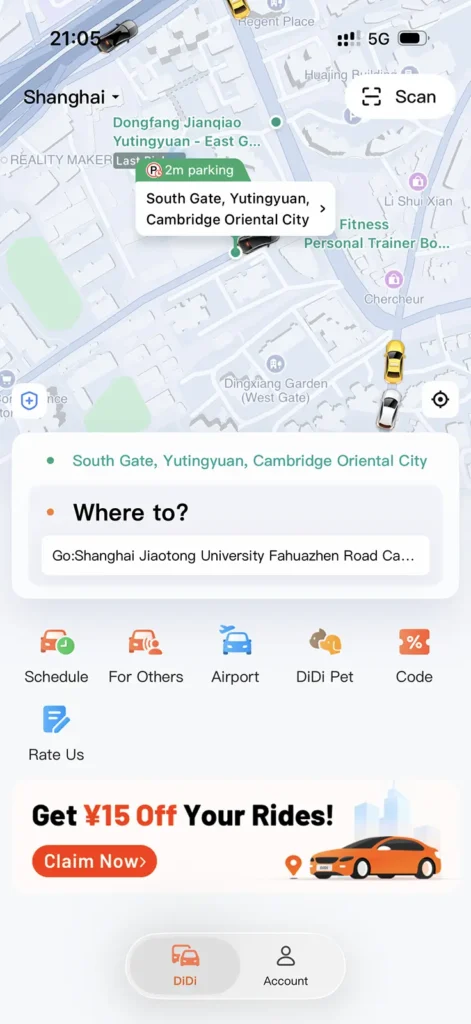
The app has an English interface and is straightforward to use. Enter your destination in English or Chinese, choose your vehicle type, and confirm the booking. Your driver’s details, vehicle, and estimated arrival time all appear on screen.
Setting up DiDi as a foreigner: Foreign phone numbers are accepted for registration. Payment can be linked through Alipay or WeChat Pay — set one of those up first and DiDi payment follows naturally. International credit cards can also be linked directly in some cases, though Alipay is the more reliable route.
Vehicle types:
- Express — standard everyday option, good for most journeys
- Premier — higher-end cars, worth it for airport runs
- Taxi — flags real taxis through the app, useful if you prefer a metered fare
Practical tips:
- Screenshot your destination address in Chinese characters before you travel — useful if there’s any confusion with the driver
- Driver cancellations can happen, particularly during peak hours — simply rebook
- In-app messaging uses auto-translation, which works well enough for basic communication
For a full overview of getting around Shanghai including the metro, see our Shanghai travel essentials guide.
You can download DiDi from the official DiDi international site.
Amap (高德地图)
Amap, also known as Gaode Maps, is the most reliable navigation app for Shanghai and the one most expats settle on for daily use. Google Maps is unreliable on the mainland — Amap is built specifically for China and is far more accurate for both driving and public transport.
The app includes an English language mode, which makes it genuinely usable for non-Mandarin speakers. Switch to English in the settings and the interface, place names, and directions all display in English. Metro routing is particularly strong — it shows which line to take, where to change, journey time, and fare.
What Amap does well:
- Metro and public transport routing with English station names
- Walking directions with accurate street-level navigation
- Real-time traffic information
- Restaurant and attraction listings with reviews
- Offline map downloads for areas you’ll use frequently
Practical tips:
- Set the app to English before you arrive — it’s much easier to do on a good connection
- Save your home address and frequently visited locations early
- For airport journeys, Amap’s public transport routing will show you the Maglev and metro options with accurate timings
Baidu Maps is an alternative but has more limited English support. iPhone users may find Apple Maps works reasonably well in Shanghai as it uses Chinese mapping data, though Amap remains more comprehensive.
Messaging & Communication
WeChat is the single most important app in China. Almost everyone uses it for messaging, and it doubles as a payment platform, mini app store, and daily services hub.
Think of it as WhatsApp, PayPal, and a services platform combined.
Typical uses:
- Messaging friends, colleagues and businesses
- Sending and receiving money
- Paying in shops and restaurants
- Accessing mini programs for taxis, train tickets, food delivery and more
Many of the other apps on this page can also be accessed through WeChat mini programs, making it the most versatile single app on this list.
Payments
Alipay
Alipay is one of the two essential payment apps for Shanghai — the other being WeChat Pay. It’s accepted almost everywhere: shops, restaurants, taxis, and street vendors via QR code.
Visitors can now link international credit cards directly to Alipay, which has made it far more accessible than it used to be. Set it up before you arrive — payments in Shanghai are almost entirely cashless.
Translation
Pleco
Pleco is widely considered the best Chinese dictionary app available and is used daily by long-term residents as well as visitors.
Particularly useful for:
- Reading menus and signs
- Camera translation — point your phone at text and it translates instantly
- Handwriting recognition for Chinese characters
- Offline functionality — works without a data connection
If you don’t speak Chinese, a few basic phrases also go a long way. See our guide to essential Chinese phrases for travellers.
Food Delivery
Ele.me and Meituan
Food delivery is a way of life in Shanghai — many residents order in daily rather than cooking. The two dominant apps are Ele.me and Meituan. Neither has a full English interface, so a translation app helps for navigating them.
In Shanghai both are widely used. Install both and compare delivery times and prices for your area.
Not sure what to order? Our Shanghai food and drink guide is a good place to start.
Finding Restaurants
Dianping
Dianping is China’s equivalent of TripAdvisor and Yelp — and considerably more useful than either for Shanghai. Locals use it constantly to check menus, photos, reviews, and opening hours.
Worth having even without Mandarin. Many restaurants offer discounted set menus exclusively through Dianping, and the volume of reviews makes it a reliable guide. Our Where to Eat in Shanghai guide covers the best spots if you want a head start.
Online Shopping
Taobao
Taobao is China’s dominant online marketplace. If you live in Shanghai, you will almost certainly end up using it — prices are often dramatically lower than physical stores, and delivery is typically one to two days.
If you prefer shopping in person, see our guide to supermarkets in Shanghai.
Before You Arrive: Final Checklist
At a minimum, have these four installed and set up before you board:
- DiDi — so you can get from the airport immediately
- Amap — so you can navigate from day one
- WeChat — essential for communication and payments
- Alipay — essential for cashless payments everywhere
Everything else on this page is worth adding once you’re settled in.
If you’re sorting out mobile data, see our guide to eSIMs for China.
Related: Getting Around Shanghai | Essential Chinese Phrases | Where to Eat in Shanghai